
Hiatal Hernia Repair
When medically appropriate, the surgeon may recommend repairing a hiatal hernia during the scheduled bariatric procedure.
All-inclusive · from$400
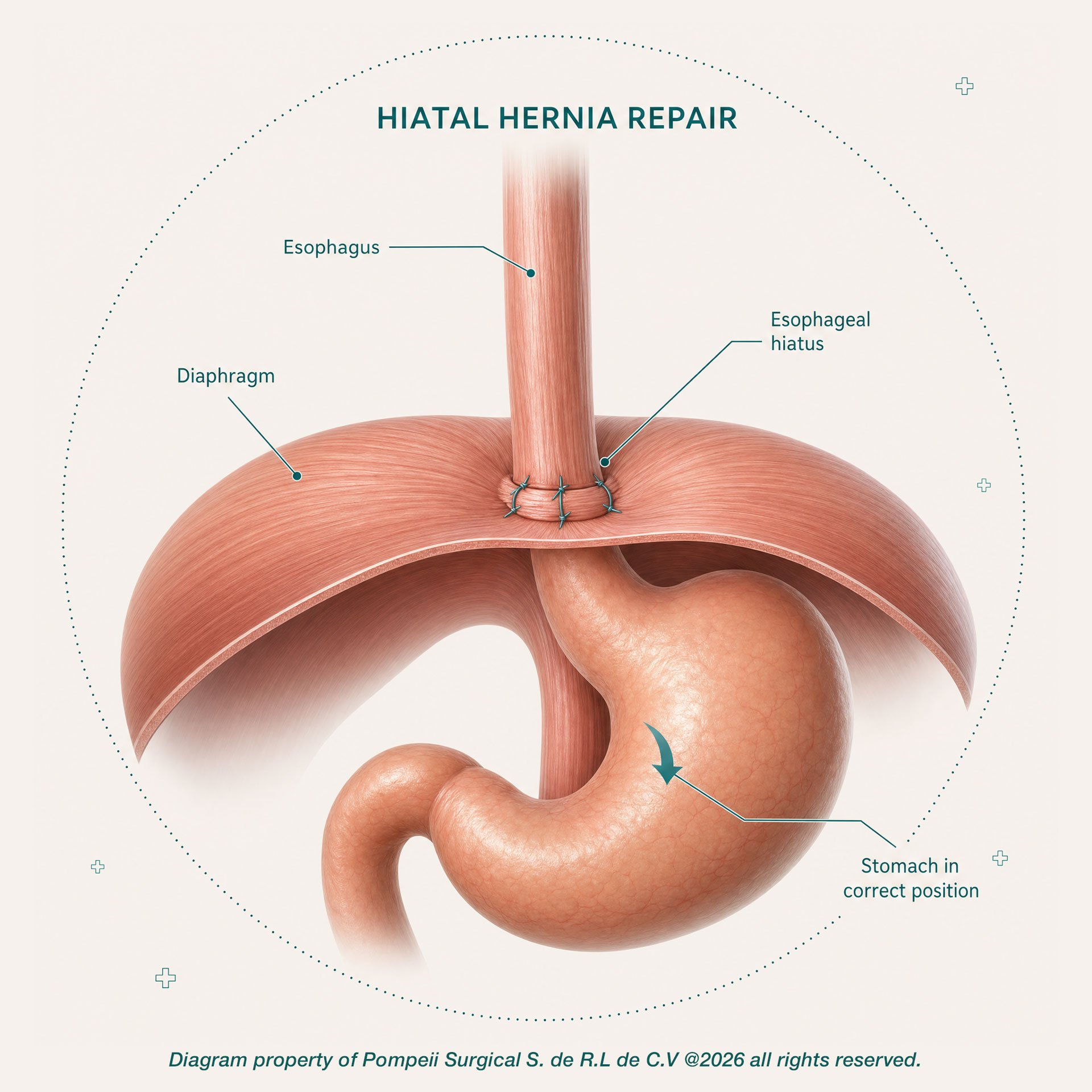
Hiatal hernia (HH): upper stomach pushes through the diaphragm — repair pulls it back.

$400
Standalone · all-inclusive

30–60 min
Laparoscopic procedure

90%+
Reflux symptom resolution

Free
When bundled with bariatric
What is a hiatal hernia?
A hiatal hernia happens when the upper part of your stomach pushes up through the diaphragm — the muscular wall that separates your chest from your abdomen. There's a small natural opening in the diaphragm called the hiatus; when that opening stretches, the stomach can slide partway through.
The result is a broken seal between your stomach and esophagus — which is the textbook recipe for chronic acid reflux, regurgitation, chest pain after meals, and difficulty swallowing. PPIs (Prilosec, Nexium) can mask the symptoms, but they don't fix the underlying anatomy.

Burning heartburn
Especially after meals or lying down — often waking patients up at night with the taste of acid in the throat.

Regurgitation
Food and acid coming back up into the throat. Often confused with "indigestion" but rooted in failed anatomy.

Chest pain after meals
Often dismissed or mistaken for cardiac issues. Hiatal hernia is a common, under-diagnosed cause.

Difficulty swallowing
Sensation of food sticking, frequent throat-clearing, chronic cough — all downstream of the broken seal.
Especially if you're getting a sleeve.
Up to 40% of bariatric patients have an undiagnosed hiatal hernia. Repairing it during your bariatric procedure costs nothing extra — and dramatically improves long-term outcomes, especially for sleeve patients.

~40%
Of bariatric patients have one
Most don't know it. Hiatal hernias are commonly discovered during pre-op imaging or sometimes only during surgery itself. Bariatric patients are at higher risk because of pressure on the diaphragm.
+30 min
Added OR time
When done as part of bariatric surgery, the repair adds only ~30 minutes to your procedure. Recovery is unchanged from a primary bariatric surgery.
Critical
For sleeve patients
An unrepaired hiatal hernia is one of the leading reasons sleeve patients develop severe GERD post-op. Repairing it at the same time as your sleeve dramatically reduces this risk.

90%+
Reflux resolution
Most patients see complete or near-complete resolution of heartburn, regurgitation, and chest pain — often eliminating PPI medications altogether.
$0
Bundled cost
Refundable cost of Hiatal Hernia cost if its not present or not repaired due to medical decision.
Same
Insurance + safety
Hiatal hernia repair is covered by the same complication insurance included with your bariatric surgery. No added paperwork, no added risk, no added charge.
How we know if you need it.
Diagnosis is straightforward: an upper endoscopy or barium swallow study reveals it clearly. Many patients don't realize they have one until imaging.
You may need a hiatal hernia repair if…
You have chronic heartburn or acid reflux, especially at night
You have chest pain after meals not explained by cardiac causes
You're a bariatric candidate — pre-op imaging will confirm or rule out
You experience regurgitation — food or acid coming back up
You have difficulty swallowing or feel food sticking
PPI medications (Prilosec, Nexium) aren't fully controlling symptoms
How we diagnose: all bariatric patients receive pre-op imaging that identifies hiatal hernias. For standalone patients, we'll review your records or arrange an endoscopy / barium swallow study to confirm.
What patients ask about hiatal hernia repair.
-
An unrepaired hiatal hernia is one of the strongest predictors of post-sleeve GERD — and post-sleeve GERD is one of the leading reasons patients eventually need conversion to bypass. If a hiatal hernia is identified before or during your sleeve, our strong recommendation is to repair it in the same surgery.
-
Laparoscopically, through 4–5 small incisions. The surgeon pulls the upper stomach back down below the diaphragm and tightens the hiatal opening with sutures (and sometimes a small mesh) to prevent the stomach from sliding up again. The procedure takes 30–60 minutes when standalone, ~30 minutes when added onto bariatric surgery.
-
For a standalone repair: 1 night in the hospital, back to work in 5–7 days, full recovery in 2–3 weeks. When bundled with bariatric surgery, recovery is identical to your bariatric procedure (the hernia repair adds no meaningful recovery time).
-
Hiatal hernia repair has a low complication rate — well under 5% in experienced hands. Possible risks include bleeding, infection, recurrence (the hernia can come back over time), and difficulty swallowing in the early weeks. Standalone procedures and bundled procedures are both covered by Pompeii's complication insurance.
-
Recurrence is possible — typically 5–10% over many years. Risk goes down with weight loss (which is why bundling with bariatric surgery is doubly powerful: the surgery fixes it AND addresses the underlying pressure). Avoiding heavy lifting for the first 6 weeks helps significantly.
-
Same answer as our bariatric pricing — lower healthcare costs in Mexico, no insurance overhead, and our scale (we perform thousands of procedures per year). U.S. self-pay hiatal hernia repair averages $8,000–$15,000.
-
U.S. insurance typically covers symptomatic hiatal hernia repair domestically — but with significant copays, deductibles, and waiting periods. Insurance generally does not cover surgery in Mexico, but for many patients the all-inclusive $400 price is significantly less than their U.S. deductible alone.
-
It's still recommended if you have one. The bypass itself is excellent for reflux — but repairing the hernia at the same time produces the best long-term results. And again, there's no added charge when bundled.
Contact Pompeii Surgical Mexico

Patient Coordination: +1 (858) 439-7931
Patient Coordination: +1 (858) 439-7979
Transportation: +1 (858) 439-7788

Email: contact@pompeii-surgical.com
Av. Diego Rivera 2550
Zona Urbana Río Tijuana
22010 Tijuana, Baja California, Mexico