
Bariatric Revision Surgery
Revision surgery may be considered when a previous bariatric procedure has resulted in weight regain, inadequate weight loss, reflux, intolerance, or another medical or anatomical concern.
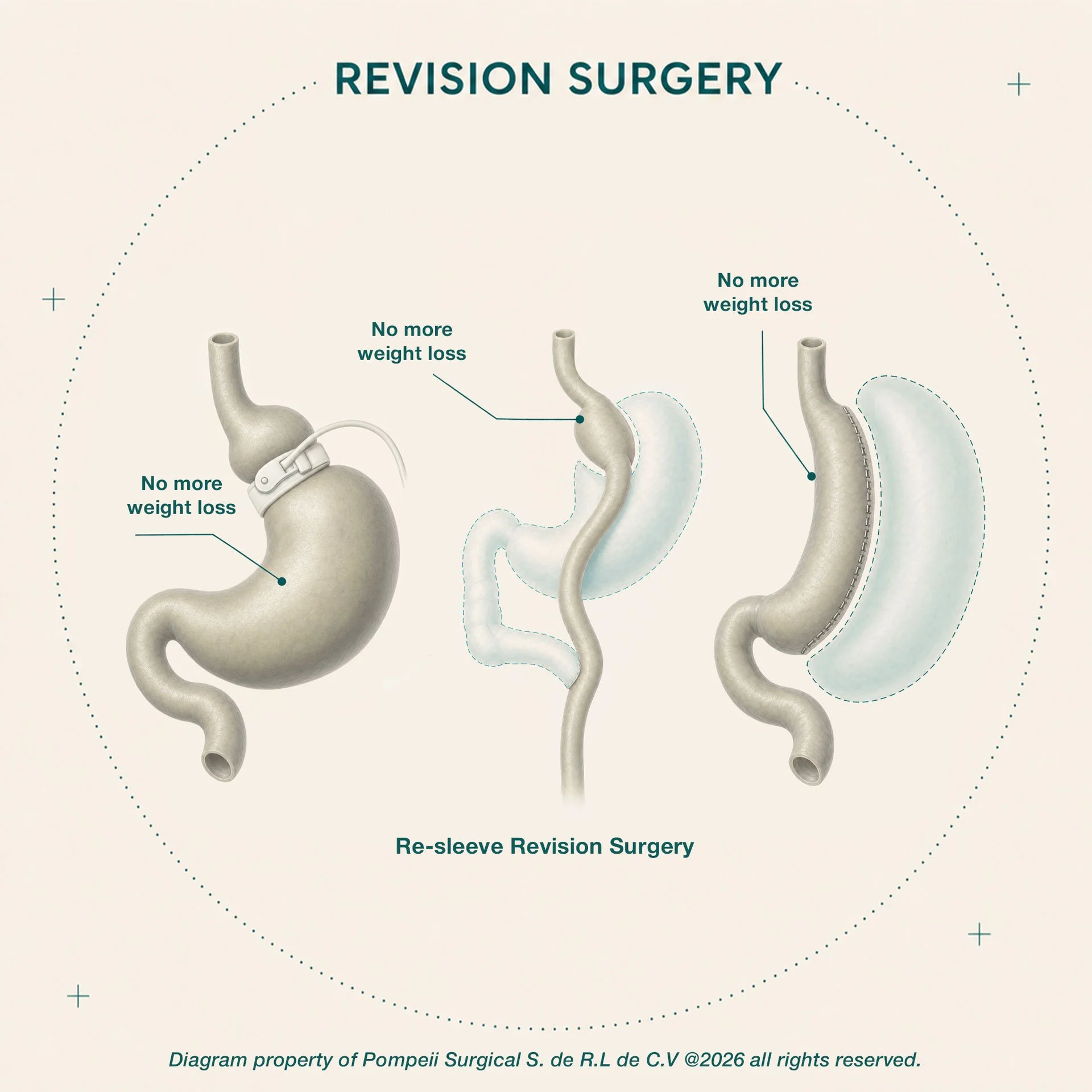
Possible options: sleeve to bypass, sleeve to mini bypass, Lap-Band removal with conversion, pouch reduction, and other revisions based on anatomy and medical need.
All-inclusive · from$5,800
2nd chance — most revisions deliver lasting results when paired with the right tool

$5,800
All-inclusive

Insured
Complication insurance included

Records
Reviewed before approval

4 paths
Sleeve → bypass · re-sleeve · band removal · pouch reset
Why revisions happen.
If you're here, you've probably been told something like "you should have tried harder." You didn't fail. Roughly 1 in 5 bariatric patients needs some form of revision over their lifetime — and it almost never has to do with willpower. It usually means the original tool wasn't matched to your body, or the anatomy stretched, or a complication developed.
The good news: revision surgery, when done by an experienced team, can deliver dramatic and lasting results. Sleeve patients converted to bypass typically lose another 60–70% of their remaining excess weight. Lap-band removals give patients their lives back. Re-sleeves restore the restriction that stretched out over time.

Inadequate weight loss
First surgery didn't deliver the loss you expected — usually because the chosen tool didn't match your physiology.

Significant weight regain
The pouch or sleeve stretched, restriction faded, and the weight has come back. A revision can re-establish the tool.

Severe reflux after sleeve
Sleeve patients sometimes develop GERD that can't be controlled with medication. Conversion to bypass is the gold-standard fix.

Lap-band complications
Slipped band, erosion, ongoing reflux, port-site pain. Most lap-band patients eventually need it removed — and often converted to a sleeve or bypass.
Which revision is right for you?
Every revision case is unique. Here are the four most common paths we perform — your coordinator will recommend the right one after Dr. Quinones reviews your medical records and prior operative report.
For stretched sleevesRe-Sleeve (sleeve revision)
from $5,800
When the original sleeve has stretched and lost its restriction, a re-sleeve trims the stomach back down to the proper banana shape. Less complex than conversion to bypass — same recovery as a primary sleeve.
Best for: stretched pouch, restored restriction needed
Typical re-loss: 40–60% of regained weight
Surgery time: ~1.5 hours
Most commonSleeve → Bypass conversion
from $5,800
The most-performed revision. For patients who lost too little, regained too much, or developed severe reflux after a sleeve. The bypass adds malabsorption + metabolic effect to fix what the sleeve alone couldn't.
Best for: regain, inadequate loss, severe GERD
Typical re-loss: 60–70% of remaining excess weight
Surgery time: ~2 hours
Less invasivePouch reset (endoscopic)
case-by-case
For some bypass patients with mild regain and a slightly stretched pouch, an endoscopic procedure can tighten the pouch outlet without re-doing the surgery. Recovery is faster — but the effect is more modest than full revision.
Best for: mild regain, intact bypass anatomy
Typical re-loss: 15–30% of regained weight
Recovery: 1–2 days
Don't know which is right? That's exactly why we review your records first. Send us your prior operative report and recent imaging — we'll come back with an honest recommendation.
Send my records →
Old technologyLap-Band removal + conversion
from $5,800
Lap-band is largely retired in modern bariatrics. Most patients eventually need it removed — and many opt to convert directly to a sleeve or bypass in the same surgery. We do both stages in one OR session whenever it's safe.
Best for: slipped, eroded, or ineffective bands
Conversion options: sleeve or bypass
Surgery time: 2–3 hours
Who is a revision candidate?
Revisions are inherently more complex than first-time surgeries. We're careful — and that's a good thing. Here's what we look for.
You're likely a strong candidate if…
It's been at least 18 months since your last bariatric surgery
You can provide your operative report from the prior surgery
You don't have uncontrolled severe heart, lung, or liver conditions
You've made a real effort with diet & lifestyle and the tool has plateaued
You can provide recent upper-GI imaging (we can help arrange this)
You're between 18 and 70 years old (exceptions by case)
The records review matters. Unlike primary surgery, we cannot safely approve a revision without knowing exactly what was done, where the staple lines are, and what the current anatomy looks like. Send your records and we'll review them — no obligation →
What's different about revisions.
We're going to be direct, because you deserve to know. Revisions are not the same as primary bariatric surgery, and you should hear that from us before you commit.
+30%
Longer in the OR
Revision surgeries typically take 30–60% longer than the equivalent primary procedure because of scar tissue and altered anatomy. Surgery time isn't a measure of risk on its own — but it's why surgeon experience matters even more.
Volume
Why surgeon experience matters
Every pound lost removes ~4 lbs of force on your knees. Back, hip, and knee pain often transform within months.
2–3x
Slightly higher complication rate
The bypass is the gold-standard fix for severe acid reflux. Patients routinely stop PPI medications and sleep flat for the first time in years.

+1 day
Slightly longer recovery
The vast majority of patients with obstructive sleep apnea see dramatic improvement — many can retire the CPAP within 6–12 months.

Always
Records review required
We require your operative report and current imaging before we can approve any revision. This is non-negotiable and it protects you. If you don't have these, we help you get them.
Honest
We say "no" when needed
Weight loss restores hormonal balance. Reduced depression and anxiety, restored self-esteem, improved libido, and often successful conception after years of infertility.
Complication insurance included | Full refund if ineligible | Surgery in 2–4 weeks
One price. Everything included. No surprises.
U.S. self-pay gastric bypass averages $25,000–$35,000 — often with add-on charges layered on top. At Pompeii, what you see is what you pay.
Revision Procedure
All-Inclusive Package
$5,800 USD
vs $25,000–$35,000self-pay in the U.S.
What's included
✓ Records review & imaging coordination
✓ Pre-op testing & consultation
✓ Surgery with our board-certified surgical team
✓ 3 nights at the Surgical Center
✓ Anesthesia & all medications
✓ Ground transport (airport / border)
✓ Complication insurance
✓ Lifetime aftercare & community
Step-by-step, with extra care at every checkpoint.
Revisions follow a similar path to primary surgery — with one critical addition at the front: medical record review. Here's exactly how it unfolds.
01
Step 1 · Apply & Send RecordsOperative report + recent imaging
Apply online and email us your operative report from the prior surgery, plus any recent upper-GI imaging. If you don't have these, we'll help you request them from your previous surgeon. This is the most important step — it's how we know whether revision is safe and which path is best.
02
Step 2 · Surgical ReviewYour case is reviewed personally by our surgical team
Your records are reviewed by our bariatric surgical team. Within a few business days you'll get an honest answer: which revision (if any) is right, what the expected results look like, and any concerns we see. If we don't think revision is safe yet, we'll tell you.
03
Step 3 · Approval & SchedulingDate locked
Once approved, your coordinator schedules your surgery date, and provides your detailed pre-op instructions. Most revision patients fly within 3–5 weeks of approval.
04
Step 4 · Pre-Op Liquid Diet2–3 weeks of liver shrinkage
Revision patients typically follow a slightly longer pre-op liquid diet than primary patients (3 weeks vs 2). This is critical for safe revision surgery — a smaller liver gives the surgeon more room to work around scar tissue.
05
Step 5 · Surgery in TijuanaGround transport, surgery, 4–5 hospital nights
San Diego pickup, drive to Tijuana, final labs, surgery the next morning. Most revisions stay 4 hospital nights. Our 24/7 bariatric nursing team monitors you closely. Your surgeon rounds personally.
06
Step 6 · Fly HomeGround transport back across the border
Our driver picks you up at the surgical facility and takes you back across the San Ysidro border to San Diego airport. You're home that evening. Desk workers return to work in days; physical jobs, 2 weeks.
When the stakes are higher, our commitment is too.
Because revisions carry slightly elevated risk, our protection matters more, not less. Complication insurance is included at no extra cost with every revision — surgical costs, extended hospital stays, additional nursing, even flight and hotel rebooking. And a full refund if your records show revision isn't safe to proceed.
All surgical costs & additional procedures covered
Extended hospital stays & nursing covered
Flight & hotel rebooking paid for
Full refund if revision is unsafe to proceed
Honest answersEverything else patients ask before they fly.
Real questions. Honest answers. No marketing fluff.
-
Yes. Most of our revision patients had their primary surgery at another clinic — including U.S. clinics, other Mexico clinics, and international centers. We just need your operative report and recent imaging, regardless of where the original surgery was performed. We don't judge; we just need to see the anatomy.
-
Almost certainly not. U.S. insurance rarely covers revision surgery — and when they do, it requires extensive documentation and often a 6–12 month process. Many patients find the all-inclusive Mexico price is less than their U.S. deductible plus copay. HSA/FSA accounts can sometimes be used.
-
Lower healthcare costs in Mexico — surgical staff, facility, anesthesia, medications, and overhead all cost a fraction of U.S. equivalents. We don't cut corners on the things that matter (board-certified surgeons, modern laparoscopic equipment, 24/7 nursing, the same medications). We do skip the U.S. healthcare administrative bloat. The savings get passed to you.
-
Almost certainly yes — and we do many. Most lap-band patients eventually need removal, and many opt to convert to a sleeve or bypass at the same time. The age of the band actually doesn't matter much; what matters is the current condition (slipped, eroded, intact) which we'll see on imaging. Send us your records and we'll come back with a plan.
-
In general, at least 18 months — long enough for healing to be complete, the original tool to have had a fair chance, and the anatomy to settle. There are exceptions for early complications (band slippage, leaks, severe reflux). We make this call case-by-case after reviewing records.
-
Slightly. Plan for 5–7 days in Tijuana (vs 4–5 for primary) and an extra few days off work. Most revision patients are walking the day of surgery and back to desk work within 7–10 days of getting home. Physical jobs need 3 weeks instead of 2.
-
If our records review concludes that revision isn't safe right now — bad scarring, very recent prior surgery, uncontrolled medical conditions — we'll tell you. We may recommend waiting, additional medical management, or a different path entirely. If you've already paid a deposit, you get a full refund. We'd rather lose a case than do an unsafe one.
-
Most patients can. We offer in-house financing with same-day approval, $0 down for many patients, and an average down payment of $1,800. We hold our own loans, which means transparent terms. We also work with United Medical Credit for larger balances.
Contact Pompeii Surgical Mexico

Patient Coordination: +1 (858) 439-7931
Patient Coordination: +1 (858) 439-7979
Transportation: +1 (858) 439-7788

Email: contact@pompeii-surgical.com
Av. Diego Rivera 2550
Zona Urbana Río Tijuana
22010 Tijuana, Baja California, Mexico